
My leadership brand:
Definitions of leadership have changed over time, resulting in a collection of views, frameworks, and concepts. (Raffo & Clark, 2018). Many leadership styles are not applicable today due to change the world will continue experiencing. Therefore, it is hard to say that I follow a specific leadership style. However, I do believe that some principles and values should exist in any organization. Being able to understand and motivate your followers in achieving outstanding results is a continuous process that will never stop, and all leaders should acknowledge that. Henry Kissinger once said, “The task of the leader is to get his people from where they are to where they have not been” We can never tell or predict what will be next.
Today I am a transformational leader but tomorrow I might follow a new undiscovered leadership style that will be suitable to the situation. I chose transformational leadership because it is linked with change. This leadership style focuses on motivating and creating a comfortable loving environment. Followers here feel a sense of belonging and will protect the organization from any harm. Therefore, followers will adapt to change when needed.
Personal Experience:
Rights before coming to London to get an MBA degree, I trained in a company for few months which was a horrifying experience that made me question whether I will be able to find a workplace that fits my potential in the future or not. During the few months there, the environment of the company was demotivating and unproductive because the tasks given were unexplained. all I did was sit in front of the computer and try to find investment opportunities. Additionally, employees were punished by a pay cut if mistakes were made, all decisions were made by the leader and employee empowerment rarely existed. However, now after learning various leadership styles and being able to become a team leader, I am pleased to have experienced it, as it resulted in a deeper understanding of what kind of leader I want to be. Therefore, the autocratic and transactional leadership styles used in the organization were not applicable and change must occur.
The transformational leader expresses how valued the employees are to the organization. Therefore, understanding the cultural norms and industry is important to create incentives that motivate and empower employees. (Ravanfar, 2015). As mentioned in my change management blog (figure 1), if an organization plans to transform or change from current leadership style to a different one, appropriate frameworks such as Mckinsey 7s model best describes the change strategy that such organizations has to adopt. The model help create a new strategy, structure, systems, shared values, style, staff and skills for the organization.
Feedback
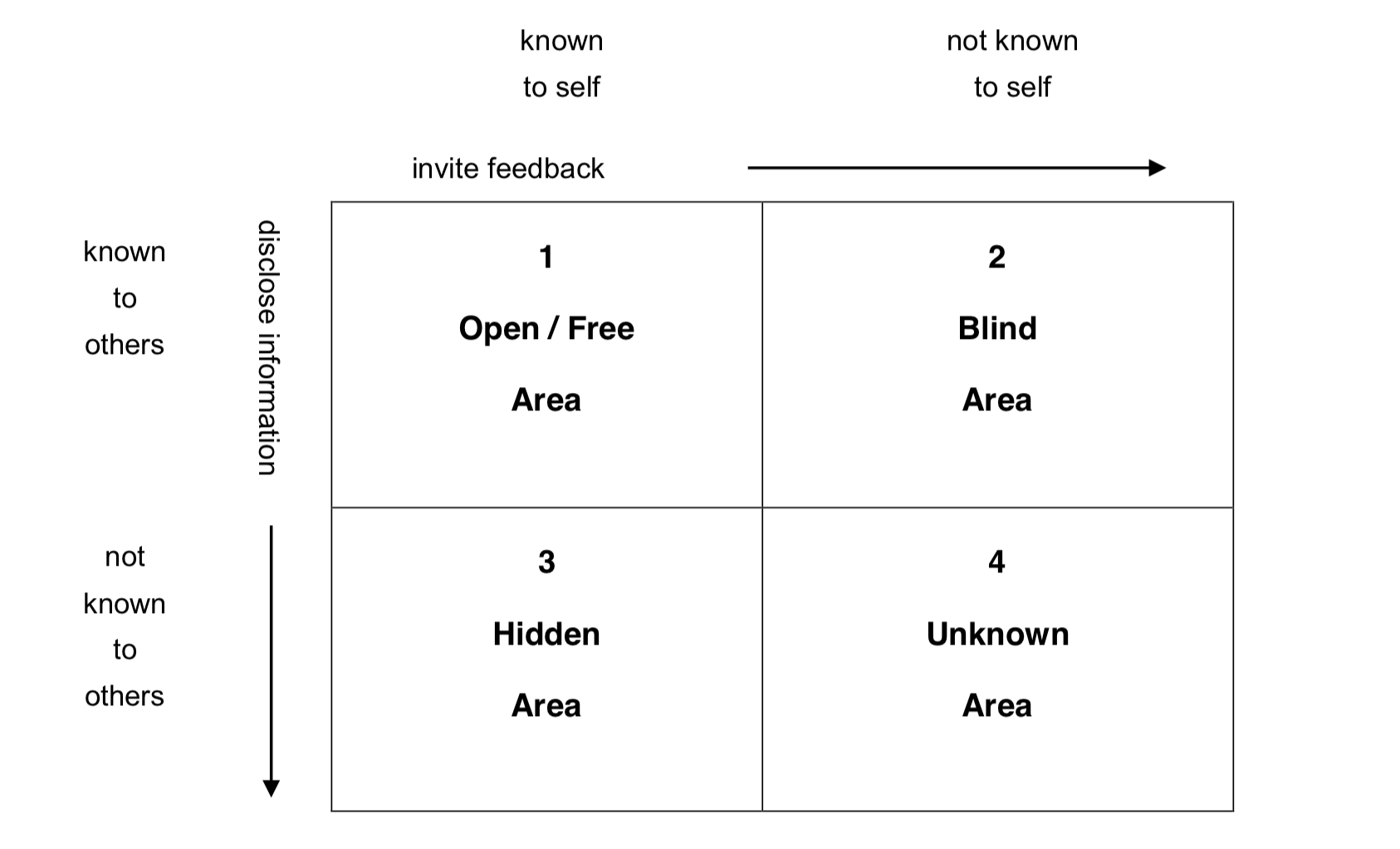
Experiencing leadership and receiving feedback is fundamental in all organizations. leaders can play a significant role in encouraging feedback from group members and giving feedback to individuals about their own blind areas. Leaders should show accountability to facilitate a culture that includes love, trust, and the sharing of knowledge in the organization. Looking at figure 1 representing the Johari window. The aim for any group should always develop an open area for each individual. also, attitudes and behavior should be known by self and known to others to become more effective and productive. (Luft & Ingham,1961)
The feedback received from my team members indicated that they felt comfortable working with me. however, there was no personal relationship from my end with the other team members. As I keep our conversations very work focused. Creating bonds outside group work could be beneficial to build comfort between teammates. Since I chose a transformational leadership style, this means I should focus more on developing relationships for motivational reasons. The feedback given to me has helped me realize areas I need to develop by creating better bonds, and this will help me develop and improve my transformational leadership style.
Development plan :
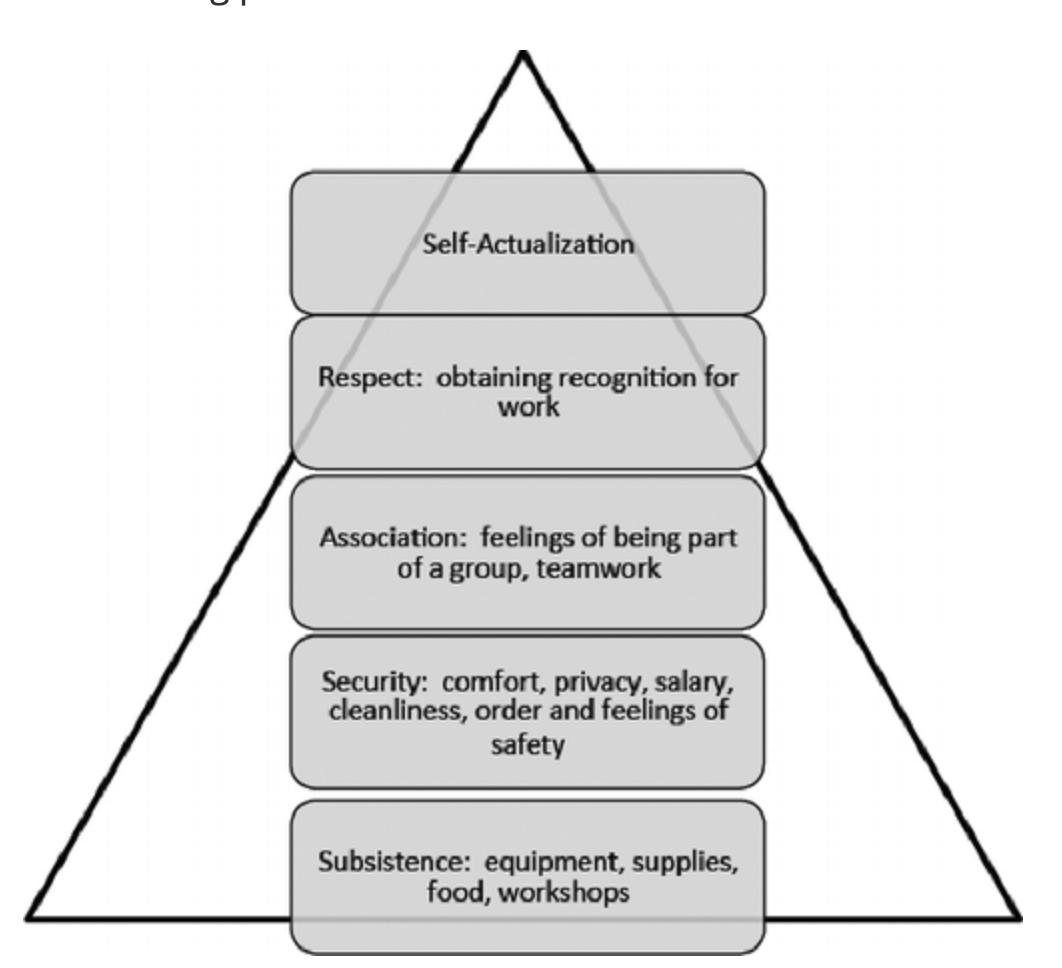
Since learning about different leadership styles, and receiving feedback from my team members, I have learnt more about myself and the importance of creating relationships with team members. When looking at the Johari window, my development plan firstly includes creating openness and open dialog with other team members, secondly understanding the needs of other team members as well as making them feel a sense of belonging in the workforce by sharing future goals and plans and allowing them to participate. This can happen by looking at figure 2 that represents the Maslow Hierarchy of Needs. Lastly, by creating incentives and appraisal as a form of motivation.
References:
Luft, J., & Ingham, H. (1961). The johari window. Human relations training news, 5(1), 6-7.
Raffo, D. M., & Clark, L. A. (2018). Using Definitions to Provoke Deep Explorations into the Nature of Leadership. Journal of Leadership Education, 17(4).
Ravanfar, M. M. (2015). Analyzing Organizational Structure based on 7s model of McKinsey. Global Journal of Management And Business Research.
Fisher, M. H., & Royster, D. (2016). Mathematics teachers’ support and retention: using Maslow’s hierarchy to understand teachers’ needs. International Journal of Mathematical Education in Science and Technology, 47(7), 993-1008
 Business Talk
Very interesting to see your progress as a leader! – In your previous work experience, what strategy or leadership style would you suggest the company to implement in order to increase job satisfaction and staff performance?
LikeLike
Thank you for your comment! I believe that my previous work place lacked proper motivation. Therefore , transformational leadership style would be suitable to solve the problem. Additionally , other leadership styles such as democratic leadership style that encourages others to participate would be appropriate.
LikeLiked by 1 person
Interesting to see how the understanding of the concept reflect on your self awareness however, do you think being a transformational leader be better where the work environment demands a transactional leader?
LikeLike
Thank you for your comment, Transformational leadership is linked with transactional leadership. To explain , motivational mechanisims exist in both , Therefore , transformational would be better in my opinion
LikeLike
Your blog topic was very interesting as I had a very similar experience to you in my work experience. Do you think each culture requires a different type of leadership style or can it be a one fits all?
LikeLike
Thank you for your comment ! After reading about Hofstede’s cultural dimentions theory, it is clear that every country/region has different cultures and habits, therefor there should be some adjustments between every culture. However some main principles such as motivation should be used in every culture.
LikeLike
Why do you think it is important to understand the cultural norms and culture of an organisation?
LikeLike